Why AI Needs Structure, Not Just Answers
Most AI tools give you one answer from one perspective. You type a question, get a response, and move on. It feels productive, but something is missing — the thinking itself.
When a team debates a decision, the value isn’t just the final answer. It’s the tension between optimism and caution. The moment someone asks “but what if we’re wrong?” The quiet insight from the person who sees the problem differently. That’s where good decisions come from — not from any single voice, but from the collision of perspectives.
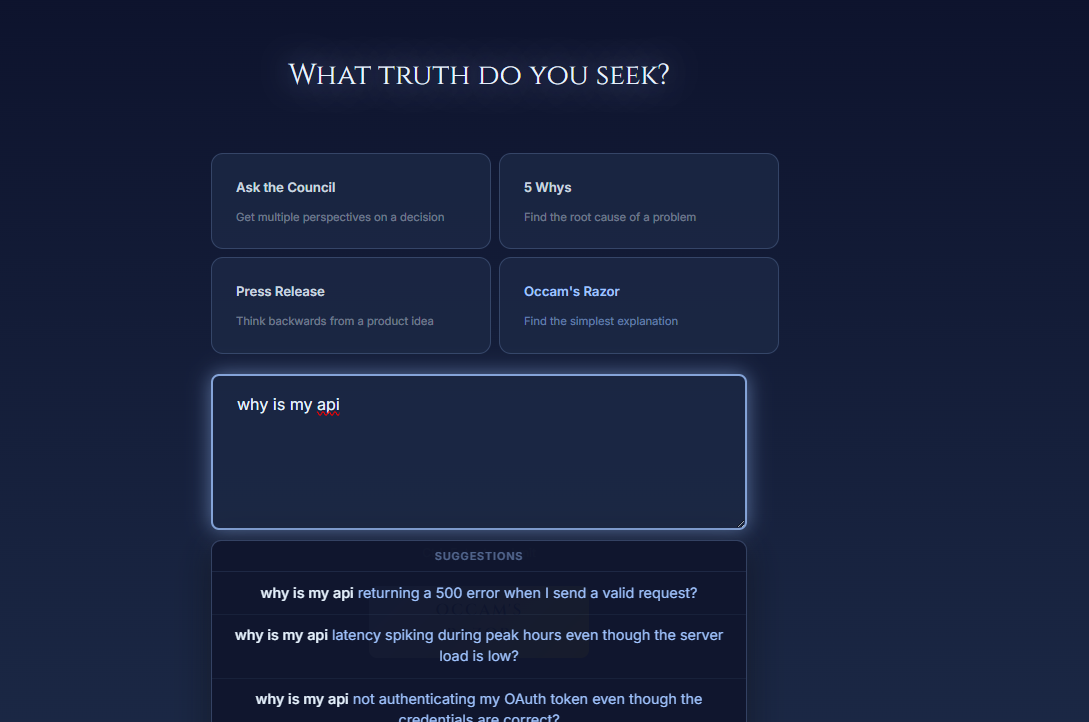
We built the Council of Birds to bring that kind of structured thinking to AI. The name comes from an old idea: that wisdom isn’t held by one voice, but emerges when many gather — each seeing from a different perch. It’s not a chatbot. It’s a set of reasoning tools that help you think better.
The Problem with the Single Prompt
Ask an AI “Should we rewrite our backend in Rust?” and you’ll get a balanced-sounding answer. But “balanced” isn’t the same as “thorough.” A truly thorough answer would separate the facts from the emotions, the risks from the opportunities, the creative alternatives from the safe defaults. And it would let you see each of those layers independently, so you can weigh them yourself.
That’s what structured thinking frameworks do. They don’t make decisions for you — they make sure you’ve actually thought it through.
Four Tools, Four Ways to Think
Ask the Council — Six Thinking Hats
Based on Edward de Bono’s framework, the Council assigns different AI agents to think from specific perspectives:
- White Hat: What do we actually know? What data do we have?
- Red Hat: What does intuition say? What feels right or wrong?
- Yellow Hat: What’s the best case? What opportunities exist?
- Black Hat: What could go wrong? What are the risks?
- Green Hat: What else could we do? What are the alternatives?
- Blue Hat: What does it all mean? How do we synthesize this?
Each perspective is explored by multiple AI agents using different models — so you don’t just get one opinion per angle, you get genuine deliberation. The Blue Hat then weaves everything together into a final synthesis.
This matters because humans naturally default to one or two thinking modes. Optimists skip the risks. Pessimists dismiss the opportunities. The Council forces all perspectives onto the table.
5 Whys — Root Cause Analysis
When something goes wrong, the first explanation is almost never the real one. “The deploy failed” is a symptom. Why did it fail? The config was wrong. Why was the config wrong? It was manually edited. Why was it manually edited? There’s no automation. Why is there no automation? Nobody prioritized it.
The 5 Whys tool walks you through this layer by layer. At each step, the AI proposes a cause, and you decide: accept it, reject it and get a new suggestion, edit it with your own knowledge, or mark it as the root cause.
The interactive loop is the key. The AI brings pattern recognition across thousands of failure modes. You bring context about your specific situation. Together, you get to the root faster than either could alone.
Press Release — Working Backwards
Amazon famously writes the press release before building the product. The idea is simple: if you can’t describe why a customer would care, you shouldn’t build it yet.
This tool generates a full press release from your product idea, then lets you refine it through feedback rounds. When the press release feels right, it generates the tough FAQ — the questions stakeholders and customers will actually ask.
It works because writing forces clarity. Vague ideas survive in slide decks and brainstorms. They don’t survive a press release that has to answer “so what?” in the first paragraph.
Occam’s Razor — Find the Simplest Explanation
When you’re faced with a puzzling situation — sales dropped, a system is behaving strangely, something doesn’t add up — there are usually multiple possible explanations. Some simple, some elaborate.
Occam’s Razor helps you compare them. The AI generates competing theories, surfaces the hidden assumptions each one depends on, and lets you check off the ones you can verify. The theory that requires the fewest unproven leaps of faith rises to the top.
This is powerful because humans are drawn to complex explanations. A conspiracy theory feels more satisfying than “someone made a typo.” But in practice, the simple explanation is right far more often. This tool makes that visible.
Why Structure Matters More Than Intelligence
The most capable AI model in the world, given a single prompt, will produce a single perspective. It might be a brilliant perspective, but it’s still one lens on the problem.
Structure multiplies the value of AI by forcing it to think from angles it wouldn’t naturally explore. It’s the difference between asking one very smart person and convening a panel of people who each see the problem differently.
This isn’t a new idea. De Bono’s Six Thinking Hats is from 1985. The 5 Whys originated at Toyota in the 1930s. Amazon’s Working Backwards has been internal practice for over a decade. Occam’s Razor is from the 14th century. These frameworks have survived because they work. What’s new is that AI makes them accessible to anyone, instantly, without needing a facilitator or a room full of people.
The Bigger Picture
The initial excitement of “AI can answer anything” is giving way to a harder question: how do we use it to actually think better?
The answer isn’t more powerful models. It’s better frameworks for using the models we already have. A structured approach with a fast model will consistently outperform an unstructured approach with the most powerful model available.
That’s the bet behind the Council of Birds: that the future of AI isn’t just faster answers, but better questions — asked from more angles, challenged from more directions, and synthesized with more care.
The tools are live at https://council.symphonytek.dk/. Try them with a real decision you’re facing. You’ll feel the difference between asking AI and thinking with AI.